What Does a Food Broker Do? Costs, Commission and When You Need One
What a food broker does, how brokers are paid, typical commission, broker vs distributor, and how to decide if your CPG brand needs one.
A food broker is an independent sales agency that represents CPG brands to retail buyers. Brokers pitch your products, manage the buyer relationship, handle promotions and help keep items in stock. They don't buy your product. They are usually paid a commission on sales, often in the range of 3 to 5 percent, and some charge a monthly retainer for new brands.
What a food broker does
- Presents your items to buyers at category and line reviews
- Knows each retailer's timing, requirements and people
- Plans and manages promotions with the retailer
- Checks stores for pricing, placement and out-of-stocks
- Helps resolve deductions and chargebacks
Food broker vs distributor
A distributor, such as UNFI or KeHE, buys your product, stores it and delivers it to stores. A broker sells your product to the retailer but never owns it. Many brands need both: a distributor to move the product and a broker to sell it.
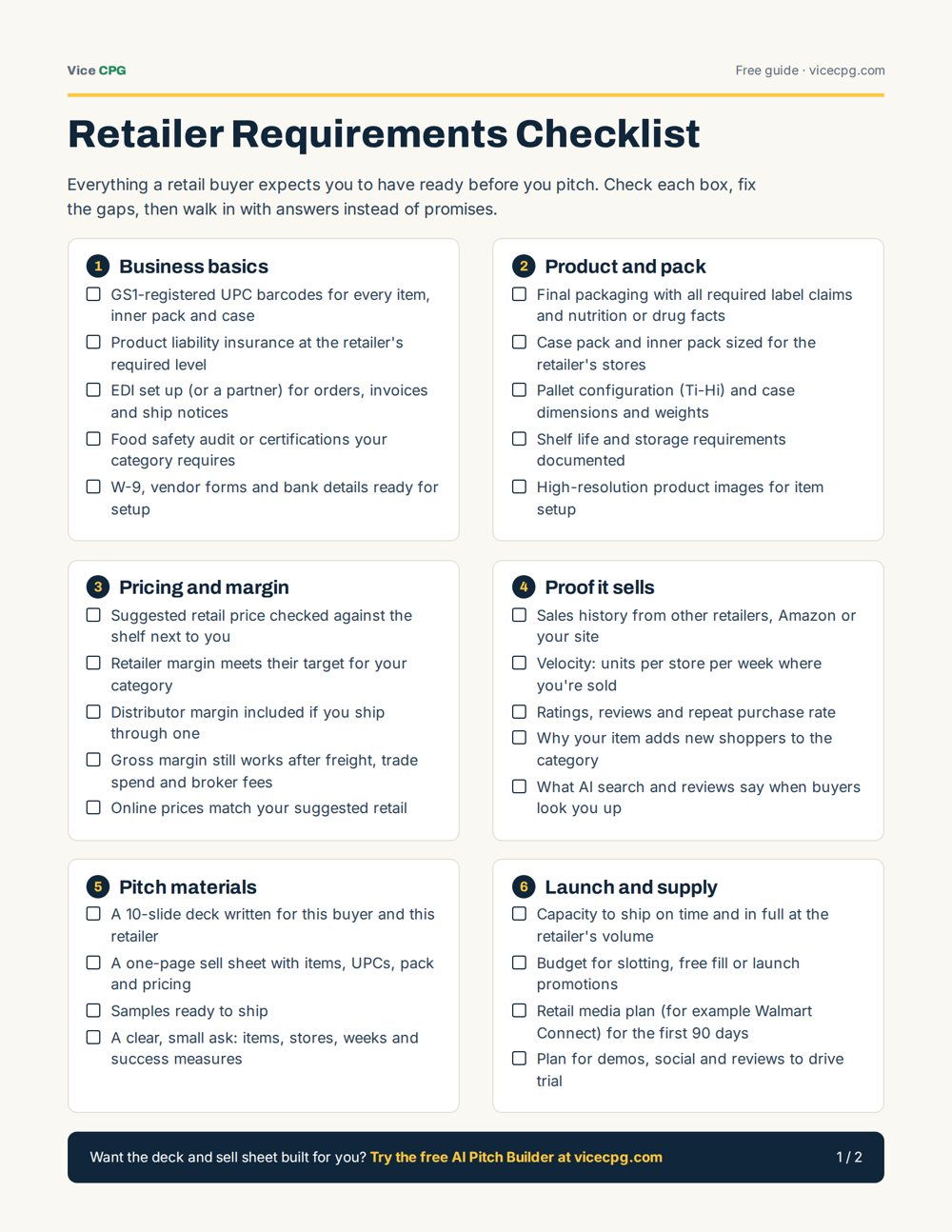
Retailer Requirements Checklist
Everything a retail buyer expects you to have ready before you pitch: barcodes, pack, pricing, proof, pitch materials and launch plan.
Get the checklistHow food brokers are paid
Most brokers take a commission on your net sales to the retailers they cover, commonly 3 to 5 percent. Brokers taking on a new, small brand may ask for a monthly retainer or a minimum fee until sales grow. Get the terms in writing, including which retailers they cover and how you can end the agreement.
Do you need a food broker?
A broker makes sense when you are selling into many retailers, need someone in front of buyers regularly, or are entering a new region. If you are pitching one or two retailers, you may be able to do it yourself with strong materials and a clear plan. Many brands start direct and add a broker as they grow.
How to choose a food broker
- Check their retailersMake sure they call on the exact retailers and regions you want.
- Check their categoriesA broker strong in frozen may not know personal care.
- Look at their bookToo many competing brands can mean less attention for yours.
- Ask for resultsAsk what they have launched recently and how those items are doing.
- Agree on goalsSet clear targets for new stores and sales in year one.
Questions
How much does a food broker cost?
Commonly 3 to 5 percent of net sales, sometimes with a monthly retainer for new brands. Terms vary by broker, region and channel.
Ca Vice CPG replace a food broker?
Vice CPG prepares the pitch deck, sell sheet, pricing and plan. Many brands use Vice CPG with their broker so the broker walks in stronger. Brokers also use Vice CPG to prepare pitches for the brands they carry.
What is the difference between a broker and a sales agency?
In CPG the terms are often used the same way. Both represent brands to retailers for a commission.
See where your product stands
Related guides
How to Pitch a Retail Buyer (and Win the Line Review)
How to pitch a retail buyer: when category and line reviews happen, what buyers want to see, how to structure a retail pitch deck, and how to follow up.
Trade Spend: What It Is and How to Manage It
What trade spend is in CPG, the main types (TPRs, off-invoice, billbacks, slotting), typical budgets, and how to plan and track it so it pays back.
How to Become a Walmart Supplier
How to become a Walmart supplier: requirements, the application, what the buyer looks for, how line reviews work, and how to keep your item on the shelf.