Wholesale Pricing and Retail Margin: How to Price a CPG Product
How to set wholesale and retail prices for a CPG product: keystone pricing, margin vs markup, what retailers and distributors expect, and a worked price waterfall.
Work backward from the shelf price shoppers will pay. Take out the retailer's margin, then the distributor's margin, and what's left is your wholesale price. Make sure that price still covers your cost of goods, freight, trade spend and a profit. Keystone pricing means the retail price is double the wholesale price, which gives the retailer a 50 percent margin.
Margin vs markup
Retailers talk in margin, not markup. Margin is profit divided by the selling price. Markup is profit divided by cost. An item the store buys for $2.00 and sells for $4.00 has a 100 percent markup and a 50 percent margin. Mixing them up is one of the most common pricing mistakes brands make with buyers.
What is keystone pricing?
Keystone pricing means doubling the wholesale cost to set the retail price. It is common in specialty and gift retail. Most grocery and mass retailers work on lower margins, so don't assume keystone.
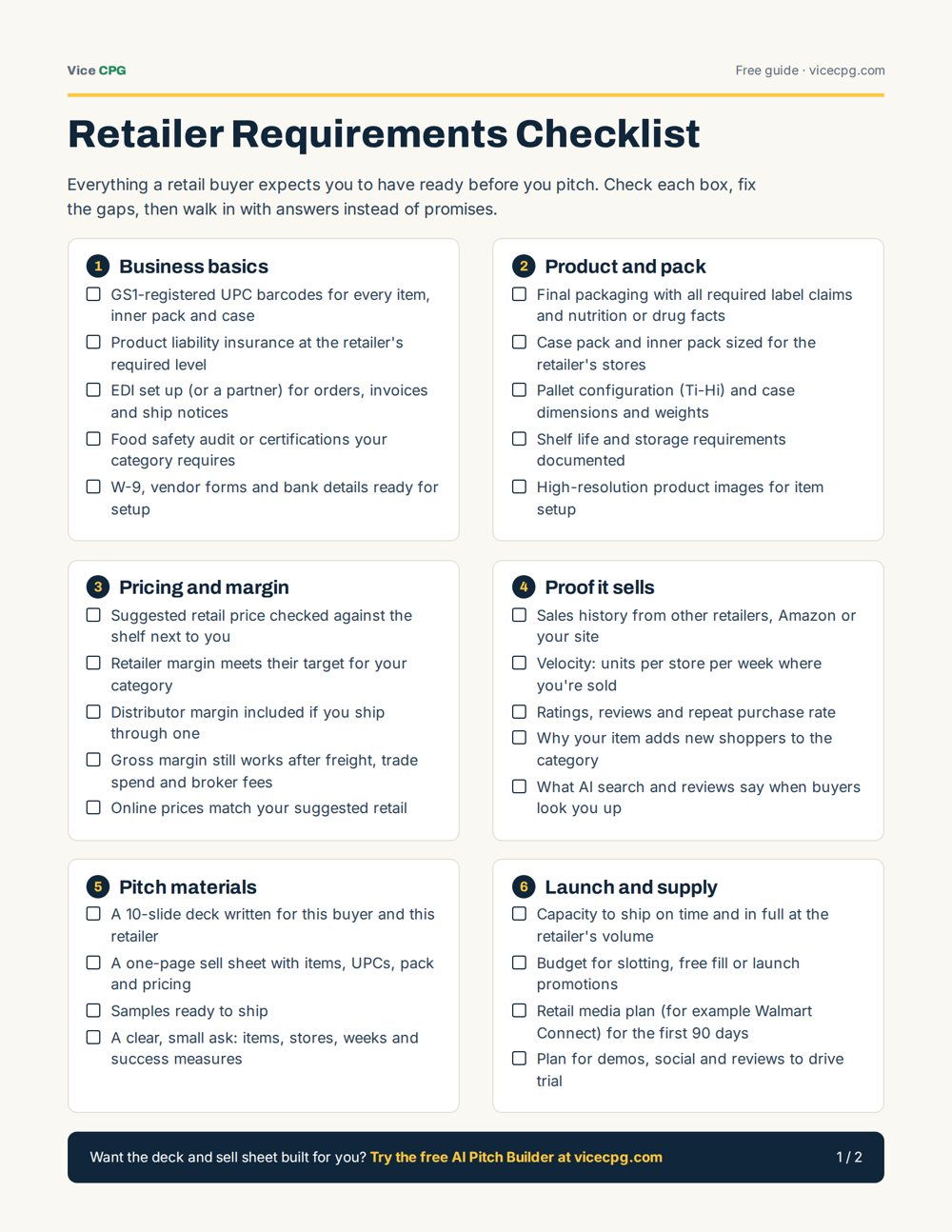
Retailer Requirements Checklist
Everything a retail buyer expects you to have ready before you pitch: barcodes, pack, pricing, proof, pitch materials and launch plan.
Get the checklistWhat margin do retailers expect?
It depends on the retailer and category. As a rough guide, conventional grocery margins often fall between 25 and 40 percent, natural and specialty retailers often expect 35 to 45 percent, and distributors typically add 15 to 30 percent on top. Your buyer or broker can tell you the target for your category.
A worked price waterfall
From that 46 percent you still pay freight, trade spend, broker commission and marketing. If there is not enough left, change the pack, the cost or the retailer before you pitch.
| Shelf price the shopper pays | $4.99 |
| Retailer margin (35%) | $1.75 |
| Retailer's cost from distributor | $3.24 |
| Distributor margin (25%) | $0.81 |
| Your wholesale price to distributor | $2.43 |
| Your cost of goods | $1.30 |
| Your gross margin | 46% |
From that 46 percent you still pay freight, trade spend, broker commission and marketing. If there is not enough left, change the pack, the cost or the retailer before you pitch.
Tips for pricing that holds
- Set one suggested retail price and protect it across channels
- Leave room for promotions without selling at a loss
- Price against the items next to you on the shelf, not just your cost
- Check your online price, since buyers will
Questions
What is a good gross margin for a CPG brand?
Many CPG brands aim for 40 percent or more gross margin on their wholesale price, so there is room for trade spend and marketing.
Is wholesale price the same as cost to the retailer?
Only if you sell direct. If you sell through a distributor, the retailer pays the distributor's price, which includes the distributor's margin.
How do I calculate the retail price from wholesale?
Divide the retailer's cost by one minus the margin. At a 35 percent margin, a $3.24 cost gives $3.24 / 0.65 = $4.99.
See where your product stands
Related guides
Trade Spend: What It Is and How to Manage It
What trade spend is in CPG, the main types (TPRs, off-invoice, billbacks, slotting), typical budgets, and how to plan and track it so it pays back.
Slotting Fees: What They Are and What They Cost
What slotting fees are, how much retailers charge, which retailers use them, the alternatives like free fill, and how to budget slotting into a launch.
How to Make a Sell Sheet Retail Buyers Actually Read
What a sell sheet is, what to put on it, the layout buyers expect, and a real example. Plus a free sell sheet template for CPG brands.